


Page 20 - AWA Vol. 42-No.4 issue
P. 20
Dairy FarmiNg

                Everything you ever wanted to know about rangelands

                                               and pastoralists
                                                                               ered by grasses, grass-like plants, forbs
                                                                               (a type of flowering plant), shrubs and
                                                                               sometimes trees where livestock can
                                                                               graze.  They cover nearly half of the
                                                                               Earth’s  land  surface  and comprise dry-
                                                                               lands, grasslands, shrublands, savannahs,
                                                                               deserts, steppes, mountain areas and
                                                                               wetlands, among other ecosystems.
                                                                                Rangelands help regulate  water and
                                                                               protect soils. In healthy rangelands,
                                                                               plants  grow  deep  roots  to  access  water
                                                                               and nutrients.  These roots hold down
                                                                               the soil while aerating it, improving soil
                                                                               structure, porosity, water infiltration and
                                                                               soil biodiversity. Plant cover also mod-
                                                                               erates surface temperatures and shields
                                                                               the soil from rain, helping stop erosion. By
                                                                               capturing up to 30 percent of the world’s
                                                                               carbon, rangelands also help mitigate cli-
                                                                               mate change.
                                                                                2. Where are rangelands?
                                                                                Unconstrained by borders, rangelands
                                                                               can be found on all continents. From the
                                                                               semi-arid plains of the Patagonian Steppe
                                                                               to the expansive grasslands of Mongolia,
                                                                               what rangelands all have in common are
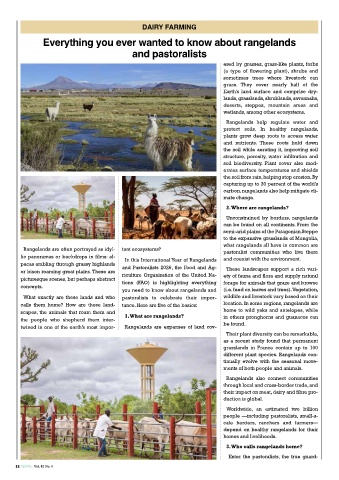
         Rangelands are often portrayed as idyl-  tant ecosystems?             pastoralist communities who live there
        lic panoramas or backdrops in films: al-  In this International Year of Rangelands   and coexist with the environment.
        pacas ambling through grassy highlands   and Pastoralists 2026, the Food and Ag-
        or bison roaming great plains. These are   riculture Organization of the United Na-  These landscapes support a rich vari-
        picturesque scenes, but perhaps abstract   tions (FAO) is highlighting everything   ety of fauna and flora and supply natural
                                                                               forage for animals that graze and browse
        concepts.
                                            you need to know about rangelands and   (i.e. feed on leaves and trees). Vegetation,
         What exactly are these lands and who   pastoralists to celebrate their impor-  wildlife and livestock vary based on their
        calls them home? How are these land-  tance. Here are five of the basics:  location. In some regions, rangelands are
        scapes, the animals that roam them and                                 home to wild yaks and antelopes, while
        the people who shepherd them inter-  1. What are rangelands?           in others pronghorns and guanacos can
        twined in one of the earth’s most impor-  Rangelands  are  expanses  of  land  cov-  be found.
                                                                                Their plant diversity can be remarkable,
                                                                               as  a  recent  study  found  that  permanent
                                                                               grasslands in France contain up to 100
                                                                               different plant species. Rangelands con-
                                                                               tinually  evolve with the seasonal  move-
                                                                               ments of both people and animals.
                                                                                Rangelands also connect communities
                                                                               through local and cross-border trade, and
                                                                               their impact on meat, dairy and fibre pro-
                                                                               duction is global.
                                                                                Worldwide,  an  estimated  two  billion
                                                                               people —including pastoralists, small-s-
                                                                               cale herders, ranchers and farmers—
                                                                               depend on healthy rangelands for their
                                                                               homes and livelihoods.
                                                                                3. Who calls rangelands home?
                                                                                 Enter the pastoralists, the true guard-

      18     Vol. 42 No. 4

