


Page 16 - AWA-41-No.1 issue
P. 16
DAIRY FARMING


             A Selected NSPase Improves Feed Efficiency


            eed is the number one expense for dairy farmers.
         FFeed has the highest impact on production costs
        and profitability. In recent years, due to a series of glob-
        al events, the cost of feed has risen and the milk margin
        over feed has shrunk. In 2023, we saw the price of dairy
        compound feed increase by almost 25%. And on top of
        that, there were high increases in other fixed costs such as
        electricity and fertilisers (IFCN, 2023). One way farmers
        can improve their profitability is by continuing to optimise
        feed efficiency and performance in the herd.
         Better feed efficiency reduces the cost of producing 1 kg
        of milk and thus increases the margin over feed. A deeper
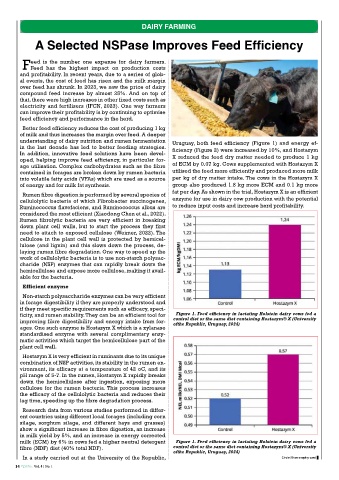
        understanding of dairy nutrition and rumen fermentation   Uruguay, both feed efficiency (Figure 1) and energy ef-
        in the last decade has led to better feeding strategies.   ficiency (Figure 2) were increased by 10%, and Hostazym
        In  addition,  innovative  feed  solutions  have  been  devel-
        oped, helping improve feed efficiency, in particular for-  X reduced the feed dry matter needed to produce 1 kg
        age utilisation. Complex carbohydrates such as the fibre   of ECM by 0.07 kg. Cows supplemented with Hostazym X
        contained in forages are broken down by rumen bacteria   utilised the feed more efficiently and produced more milk
        into volatile fatty acids (VFAs) which are used as a source   per kg of dry matter intake. The cows in the Hostazym X
        of energy and for milk fat synthesis.                 group also produced 1.8 kg more ECM and 0.1 kg more
                                                              fat per day. As shown in the trial, Hostazym X is an efficient
         Rumen fibre digestion is performed by several species of
        cellulolytic bacteria of which Fibrobacter succinogenes,   enzyme for use in dairy cow production with the potential
        Ruminococcus flavefaciens, and Ruminococcus albus are   to reduce input costs and increase herd profitability.
        considered the most efficient (Xiaodong Chen et al., 2022).
        Rumen fibrolytic bacteria are very efficient in breaking
        down plant cell walls, but to start the process they first
        need to attach to exposed cellulose (Weimer, 2022). The
        cellulose in the plant cell wall is protected by hemicel-
        lulose (and lignin) and this slows down the process, de-
        laying rumen fibre degradation. One way to speed up the
        work of cellulolytic bacteria is to use non-starch polysac-
        charide (NSP) enzymes that can rapidly break down the
        hemicellulose and expose more cellulose, making it avail-
        able for the bacteria.
         Efficient enzyme
         Non-starch polysaccharide enzymes can be very efficient
        in forage digestibility if they are properly understood and
        if they meet specific requirements such as efficacy, speci-
        ficity, and rumen stability. They can be an efficient tool for   Figure 1. Feed efficiency in lactating Holstein dairy cows fed a
        improving fibre digestibility and energy intake from for-  control diet or the same diet containing Hostazym® X (University
                                                              ofthe Republic, Uruguay, 2024)
        ages. One such enzyme is Hostazym X which is a xylanase
        standardised enzyme with several complimentary enzy-
        matic activities which target the hemicellulose part of the
        plant cell wall.
         Hostazym X is very efficient in ruminants due to its unique
        combination of NSP activities, its stability in the rumen en-
        vironment, its efficacy at a temperature of 42 oC, and its
        pH range of 5-7. In the rumen, Hostazym X rapidly breaks
        down the hemicellulose after ingestion, exposing more
        cellulose for the rumen bacteria. This process increases
        the efficacy of the cellulolytic bacteria and reduces their
        lag time, speeding up the fibre degradation process.
         Research data from various studies performed in differ-
        ent countries using different local forages (including corn
        silage, sorghum silage, and different hays and grasses)
        show a significant increase in fibre digestion, an increase
        in milk yield by 5%, and an increase in energy corrected
        milk (ECM) by 6% in cows fed a higher neutral detergent   Figure 1. Feed efficiency in lactating Holstein dairy cows fed a
        fibre (NDF) diet (40% total NDF).                     control diet or the same diet containing Hostazym® X (University
                                                              ofthe Republic, Uruguay, 2024)
         In a study carried out at the University of the Republic,                                  Circle 20 on enquiry card
       14      Vol. 41 No. 1

