


Page 27 - Vol.38-No.2
P. 27
CROP PROTECTION


                                                • Only use clean and dry (prefer-
                                              ably new) jute or sisal sacks. This
                                              avoids  risk  of  contamination  and
                                              moisture absorption by the grain.
                                              If grain is earmarked for transit to
                                              a more humid zone then it should
                                              be  packaged  in  polythene  sacks.
                                              However, only optimally dry grain
                                              should  be  packed  in  polythene
                                              sacks,  or  paper  sacks  with  poly-
                                              thene  liners.  Polythene  not  only
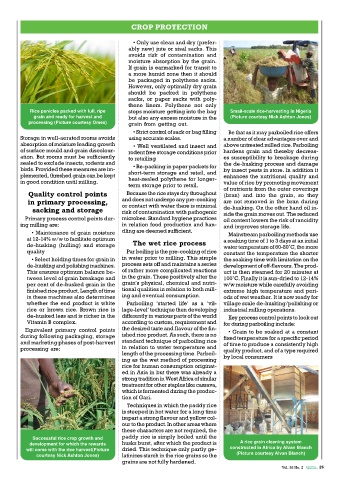
            Rice panicles packed with full, ripe   stops moisture getting into the bag   Small-scale rice-harvesting in Nigeria
             grain and ready for harvest and   but also any excess moisture in the   (Picture courtesy Nick Ashton Jones)
           processing (Picture courtesy Omex)
                                              grain from getting out.
                                                s 6WULFW FRQWURO RI VDFN RU EDJ ÞOOLQJ   Be that as it may parboiled rice offers
        Storage in well-aerated rooms avoids   using accurate scales.           a number of clear advantages over and
        absorption of moisture leading growth   • Well ventilated and insect and   above untreated milled rice. Parboiling
        of surface mould and grain discolour-  rodent free storage conditions prior   hardens grain and thereby decreas-
        DWLRQ  %XW URRPV PXVW EH VXIÞFLHQWO\   to retailing                     es susceptibility to breakage during
        sealed to exclude insects, rodents and                                  the de-husking process and damage
                                                • Re-packing in paper packets for
        birds. Provided these measures are im-                                  by insect pests in store. In addition it
                                              short-term storage and retail, and
        plemented, threshed grain can be kept                                   enhances the nutritional quality and
                                              heat-sealed polythene for longer-
        in good condition until milling.                                        value of rice by promoting movement
                                              term storage prior to retail.
                                                                                of nutrients from the outer coverings
           Quality control points             Because the rice stays dry throughout   (bran)  and  into  the  grain,  so  they
           in primary processing,           and does not undergo any pre-cooking   are  not  removed  in  the  bran  during
            sacking and storage             or contact with water there is minimal   de-husking. On the other hand oil in-
                                            risk of contamination with pathogenic
          Primary process control points dur-  microbes. Standard hygiene practices   side the grain moves out. The reduced
                                                                                oil content lowers the risk of rancidity
        ing milling are:                    in relation food production and han-  and improves storage life.
            • Maintenance of grain moisture   GOLQJ DUH GHHPHG VXIÞFLHQW         Mainstream parboiling methods use
          at 12-14% w/w to facilitate optimum                                   a soaking time of 1 to 3 days at an initial
          de-husking  (hulling)  and  storage   The wet rice process            ZDWHU WHPSHUDWXUH RI      Ĺ&  WKH PRUH
          quality                             Par boiling is the pre-cooking of rice   constant the temperature the shorter
            • Select holding times for grain in   in water prior to milling. This simple   the soaking time with limitation on the
          de-husking and polishing machines.   process sets off and maintains a series   development of off-flavours. The prod-
          This ensures optimum balance be-  of rather more complicated reactions   uct is then steamed for 20 minutes at
          tween level of grain breakage and   in the grain. These positively alter the      Ĺ&  )LQDOO\ LW LV VXQ GULHG WR
          per cent of de-husked grain in the   grain’s physical, chemical and nutri-  w/w moisture while carefully avoiding
          ÞQLVKHG ULFH SURGXFW  /HQJWK RI WLPH   tional qualities in relation to both mill-  extreme high temperature and peri-
          in these machines also determines   ing and eventual consumption.     ods of wet weather. It is now ready for
          whether  the  end  product  is  white   3DUERLOLQJ  oVWDUWHG  OLIHp  DV  D  oYLO-  village scale de-husking/polishing or
          rice  or  brown  rice.  Brown  rice  is   lage-level’ technique then developing   industrial milling operations.
          de-husked less and is richer in the   differently in various parts of the world   Key process control points to look out
          Vitamin B complex.                according to custom, requirement and   for during parboiling include:
          Equivalent  primary  control  points   WKH GHVLUHG WDVWH DQG IODYRXU RI WKH ÞQ-  • Grain to be soaked at a constant
        during following packaging, storage   ished rice product. As such, there is no   Þ[HG WHPSHUDWXUH IRU D VSHFLÞF SHULRG
        and marketing phases of post-harvest   standard technique of parboiling rice   of time to produce a consistently high
        processing are:                     in relation to water temperature and   quality product, and of a type required
                                            length of the processing time. Parboil-
                                                                                by local consumers
                                            ing as the wet method of processing
                                            rice for human consumption originat-
                                            ed in Asia in but there was already a
                                            strong tradition in West Africa of similar
                                            treatment for other staples like cassava,
                                            which is fermented during the produc-
                                            tion of Gari.
                                              Techniques in which the paddy rice
                                            is steeped in hot water for a long time
                                            impart a strong flavour and yellow col-
                                            our to the product. In other areas where
                                            these characters are not required, the
            Successful rice crop growth and   paddy rice is simply boiled until the
           development for which the rewards   husks burst, after which the product is   A rice grain cleaning system
          will come with the rice harvest(Picture   dried. This technique only partly ge-  constructed in Africa by Alvan Blanch
              courtesy Nick Ashton Jones)   latinizes starch in the rice grains so the   (Picture courtesy Alvan Blanch)
                                            grains are not fully hardened.
                                                                                                                  25
                                                                                                    Vol. 38 No. 2

