


Page 26 - Vol.38-No.2
P. 26
CROP PROTECTION


                                                              WET AND DRY

                                                      PROCESSING OF RICE


                                            where it accounts for a sizable slice of
                                            production in the West African region.
                                            This traditional but highly specialised
                                            method of rice production has to cope
                                            and deal with a variety of problems re-
                                            lated to soil salinity and acidity, which
            DR. TERRY MABBETT               are not faced by mainstream irrigated
                                            rice farming, and because mangrove
          Striking  feature  about  rice  is  the
                                            forests are invaded by salt water.
        range of environmental conditions and
        agronomic techniques under which the   West Africa is the undisputed hub of
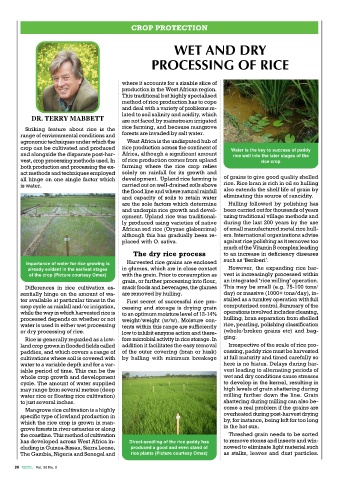
        crop can be cultivated and produced   rice production across the continent of   Water is the key to success of paddy
        and alongside the disparate post-har-  $IULFD  DOWKRXJK D VLJQLÞFDQW DPRXQW   rice well into the later stages of the
        vest, crop processing methods used. In   of rice production comes from upland        rice crop
        both production and processing the ex-  farming  where  the  rice  crop  relies
        act methods and techniques employed   solely  on  rainfall  for  its  growth  and
        all hinge on one single factor which   development.  Upland rice farming is   of grains to give good quality shelled
        is water.                           carried out on well-drained soils above   rice. Rice bran is rich in oil so hulling
                                            the flood line and where natural rainfall   also extends the shelf life of grain by
                                                                                eliminating this source of rancidity.
                                            and  capacity  of  soils  to  retain  water
                                            are the sole factors which determine   Hulling  followed  by  polishing  has
                                            and underpin rice growth and devel-  been carried out for thousands of years
                                            opment. Upland rice was traditional-  using traditional village methods and
                                            ly produced using varieties of native   during the last 200 years by the use
                                            African red rice (Oryzae glaberrima)   of small manufactured metal rice hull-
                                            although this has gradually been re-  ers. International organisations advise
                                            placed with O. sativa.              against rice polishing as it removes too
                                                                                much of the Vitamin B complex leading
                                                The dry rice process            WR DQ LQFUHDVH LQ GHÞFLHQF\ GLVHDVHV
                                                                                VXFK DV o%HULEHULp
          Importance of water for rice growing is   Harvested rice grains are enclosed
           already evident in the earliest stages   in glumes, which are in close contact   However,  the  expanding  rice  har-
           of the crop (Picture courtesy Omex)  with the grain. Prior to consumption as   vest is increasingly processed within
                                            grain, or further processing into flour,   DQ LQWHJUDWHG oULFH PLOOLQJp RSHUDWLRQ
          Differences  in  rice  cultivation  es-  snack foods and beverages, the glumes   This may be small (e.g. 75-100 tons/
        sentially hinge on the amount of wa-  are removed by hulling.           day) or massive (1000+ tons/day), in-
        ter available at particular times in the   First  secret  of  successful  rice  pro-  stalled as a turnkey operation with full
        crop cycle as rainfall and/or irrigation,   cessing  and  storage  is  drying  grain   computerised control. Summary of the
        while the way in which harvested rice is   to an optimum moisture level of 12-14%   operations involved includes cleaning,
        processed depends on whether or not   weight/weight (w/w). Moisture con-  hulling, bran separation from shelled
        water is used in either wet processing   WHQWV ZLWKLQ WKLV UDQJH DUH VXIÞFLHQWO\   ULFH  SHDUOLQJ  SROLVKLQJ FODVVLÞFDWLRQ
        or dry processing of rice.          low to inhibit enzyme action and there-  (whole/broken grains etc) and bag-
                                                                                ging.
          Rice is generally regarded as a low-  fore microbial activity in rice storage. In
        ODQG FURS JURZQ LQ IORRGHG ÞHOGV FDOOHG   addition it facilitates the easy removal   Irrespective of the scale of rice pro-
        paddies, and which covers a range of   of the outer covering (bran or husk)   cessing, paddy rice must be harvested
        cultivations where soil is covered with   by  hulling  with  minimum  breakage   at full maturity and timed carefully so
        water to a variable depth and for a var-                                here is no hiatus. Delays during har-
        iable period of time. This can be the                                   vest leading to alternating periods of
        whole crop growth and development                                       wet and dry conditions cause stresses
        cycle. The amount of water supplied                                     to develop in the kernel, resulting in
        may range from several metres (deep                                     high levels of grain shattering during
        water rice or floating rice cultivation)                                milling  further  down  the  line.  Grain
        to just several inches.                                                 shattering during milling can also be-
                                                                                come a real problem if the grains are
          Mangrove rice cultivation is a highly
                                                                                overheated during post-harvest drying
        VSHFLÞF W\SH RI ORZODQG SURGXFWLRQ LQ
                                                                                by, for instance, being left for too long
        which the rice crop is grown in man-
                                                                                in the hot sun.
        grove forests in river estuaries or along
        the coastline. This method of cultivation                                Threshed grain needs to be sorted
        has developed across West Africa in-  Direct-seedling of the rice paddy has   to remove stones and insects and win-
        cluding in Guinea-Bissau, Sierra Leone,   produced a good and even stand of   nowed to eliminate light material such
        The Gambia, Nigeria and Senegal and    rice plants (Picture courtesy Omex)  as  stalks,  leaves  and  dust  particles.
        24         Vol. 38 No. 2

