


Page 25 - Vol.38-No.2
P. 25
CROP PROTECTION


         KIWI: PROTECTA® COMPLETE PROTECTION EVEN

                                FOR ORGANIC ORCHARDS


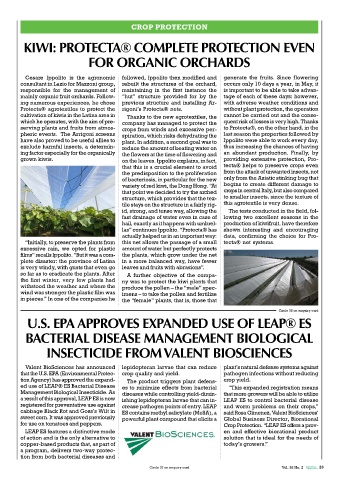
          Cesare  Ippolito  is  the  agronomic   IROORZHG  ,SSROLWR WKHQ PRGLÞHG DQG   generate  the  fruits.  Since  flowering
        consultant in Lazio for Mazzoni group,   rebuilt the structures of the orchard,   occurs only 10 days a year, in May, it
        responsible  for  the  management  of   PDLQWDLQLQJ  LQ  WKH  ÞUVW  LQVWDQFH  WKH   is important to be able to take advan-
        mainly organic fruit orchards. Follow-  “hut”  structure  provided  for  by  the   tage of each of these days: however,
        ing numerous experiences, he chose   previous structure and installing Ar-  with adverse weather conditions and
        Protecta® agrotextiles to protect the   rigoni’s Protecta® nets.        without plant protection, the operation
        cultivation of kiwis in the Latina area in   Thanks to the new agrotextiles, the   cannot be carried out and the conse-
        which he operates, with the aim of pre-  company has managed to protect the   quent risk of losses is very high. Thanks
        serving plants and fruits from atmos-  crops from winds and excessive per-  to Protecta®, on the other hand, in the
        pheric events.  The Arrigoni screens   spiration, which risks dehydrating the   last season the properties followed by
        have also proved to be useful allies to   plant. In addition, a second goal was to   Ippolito were able to work every day,
        exclude harmful insects, a determin-  reduce the amount of beating water on   thus increasing the chances of having
        ing factor especially for the organically   the flowers at the time of flowering and   an  abundant  production.  Finally,  by
        grown kiwis.                        on the leaves. Ippolito explains, in fact,   providing  extensive  protection,  Pro-
                                            that this is a crucial element to avoid   tecta® helps to preserve crops even
                                            the predisposition to the proliferation   from the attack of unwanted insects, not
                                            of bacteriosis, in particular for the new   only from the Asiatic stinking bug that
                                            variety of red kiwi, the Dong Hong. “At   begins to create different damage to
                                            that point we decided to try the arched   crops in central Italy, but also compared
                                            structure, which provides that the tex-  to smaller insects, since the texture of
                                            tile stays on the structure in a fairly rig-  this agrotextile is very dense.
                                            id, strong, and tense way, allowing the   7KH WHVWV FRQGXFWHG LQ WKH ÞHOG  IRO-
                                            fast drainage of water even in case of   lowing  two  excellent  seasons  in  the
                                            hail, exactly as it happens with umbrel-  production of kiwifruit, have therefore
                                            las” continues Ippolito. “Protecta® has   shown  interesting  and  encouraging
                                            actually helped us in an important way:   GDWD   FRQÞUPLQJ  WKH  FKRLFH  IRU  3UR-
          “Initially, to preserve the plants from   this net allows the passage of a small   tecta® net systems.
        excessive  rain,  we  opted  for  plastic   amount of water but perfectly protects
        ÞOPVr UHFDOOV ,SSROLWR  q%XW LW ZDV D FRP-  the plants, which grow under the net
        plete disaster: the province of Latina   in a more balanced way, have fewer
        is very windy, with gusts that even go   leaves and fruits with abrasions”.
        so far as to eradicate the plants. After   A  further  objective  of  the  compa-
        WKH ÞUVW ZLQWHU  YHU\ IHZ SODQWV KDG   ny was to protect the kiwi plants that
        withstood the weather and where the   produce the pollen – the “male” spec-
        ZLQG ZDV VWURQJHU WKH SODVWLF ÞOP ZDV   imens – to take the pollen and fertilize
        in pieces.” In one of the companies he   the “female” plants, that is, those that

                                                                                                   Circle 36 on enquiry card
           U.S. EPA APPROVES EXPANDED USE OF LEAP® ES

          BACTERIAL DISEASE MANAGEMENT BIOLOGICAL


                 INSECTICIDE FROM VALENT BIOSCIENCES


          Valent BioSciences has announced   lepidopteran  larvae  that  can  reduce   plant’s natural defense systems against
        that the U.S. EPA (Environmental Protec-  crop quality and yield.       pathogen infections without reducing
        tion Agency) has approved the expand-  The product triggers plant defens-  crop yield.
        ed use of LEAP® ES Bacterial Disease   es to minimize effects from bacterial   “This expanded registration means
        Management Biological Insecticide. As   diseases while controlling yield-dimin-  that more growers will be able to utilize
        a result of this approval, LEAP ES is now   ishing lepidopteran larvae that can in-  LEAP ES to control bacterial disease
        registered for preventative use against   crease pathogen points of entry. LEAP   and worm problems on their crops,”
        cabbage Black Rot and Goss’s Wilt in   ES contains methyl salicylate (MeSA), a   said Rosa Gimenez, Valent BioSciences’
        sweet corn. It was approved previously   powerful plant compound that elicits a   Global Business Director, Biorational
        for use on tomatoes and peppers.                                        Crop Protection. “LEAP ES offers a prov-
          LEAP ES features a distinctive mode                                   en  and  effective  biorational  product
        of action and is the only alternative to                                solution that is ideal for the needs of
        copper-based products that, as part of                                  today’s growers.”
        a program, delivers two-way protec-
        tion from both bacterial diseases and
                                                                                                                  23
                                                      Circle 37 on enquiry card                     Vol. 38 No. 2

