


Page 12 - Vol.38-No.2
P. 12
ANIMAL HEALTH

          NEW ZEALAND FARMING RELIES ON SMALL BUT


                            VITAL INDUSTRY, REPORT SAYS


                                              One disease that can be contracted
                                            by people via dairy cattle is Leptospi-
                                            rosis. New Zealanders had one of the
                                            highest incidences of this bacterial dis-
                                            ease in the developed world. When a
                                            vaccination programme for dairy cattle
                                            ZDV ÞUVW LQWURGXFHG LQ WKH     V  KXPDQ
                                            cases of the disease more than halved
                                            – from 11 to 4.5 incidents per 100,000
                                            people, the report highlights.
                                              By vaccinating cows, dairy milkers
                                            and meatworkers are protected from
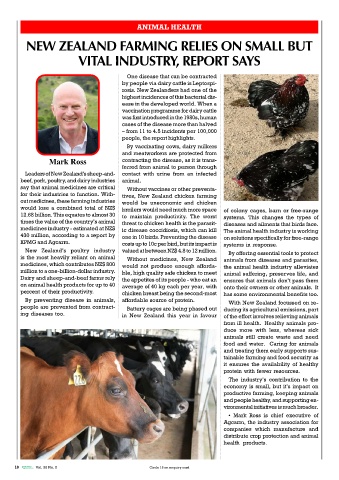
                  Mark Ross                 contracting the disease, as it is trans-
                                            ferred from animal to person through
          Leaders of New Zealand’s sheep-and-  contact  with  urine  from  an  infected
        beef, pork, poultry, and dairy industries   animal.
        say that animal medicines are critical   Without vaccines or other preventa-
        for their industries to function. With-  tives, New Zealand chicken farming
        out medicines, these farming industries   would  be  uneconomic  and  chicken
        would  lose  a  combined  total  of  NZ$   broilers would need much more space   of  colony  cages,  barn  or  free-range
        12.68 billion. This equates to almost 30   to  maintain  productivity.  The  worst   systems.  This  changes  the  types  of
        times the value of the country’s animal   threat to chicken health is the parasit-  diseases and ailments that birds face.
        medicines industry - estimated at NZ$   ic disease coccidiosis, which can kill   The animal health industry is working
        430 million, according to a report by   one in 10 birds. Preventing the disease   RQ VROXWLRQV VSHFLÞFDOO\ IRU IUHH UDQJH
        KPMG and Agcarm.                    costs up to 10c per bird, but its impact is   systems in response.
          New  Zealand’s  poultry  industry   valued at between NZ$ 4.8 to 12 million.
                                                                                 By offering essential tools to protect
        is the most heavily reliant on animal   Without  medicines,  New  Zealand   animals from diseases and parasites,
        medicines, which contributes NZ$ 800   would  not  produce  enough  afforda-  the animal health industry alleviates
        million to a one-billion-dollar industry.   ble, high quality safe chicken to meet   animal suffering, preserves life, and
        Dairy and sheep-and-beef farms rely   the appetites of its people - who eat an   ensures that animals don’t pass them
        on animal health products for up to 40   average of 40 kg each per year, with   onto their owners or other animals.  It
        percent of their productivity.      chicken breast being the second-most   KDV VRPH HQYLURQPHQWDO EHQHÞWV WRR
          By  preventing  disease  in  animals,   affordable source of protein.
                                                                                 With New Zealand focussed on re-
        people are prevented from contract-   Battery cages are being phased out   ducing its agricultural emissions, part
        ing diseases too.                   in  New  Zealand  this  year  in  favour   of the effort involves relieving animals
                                                                                from ill health.  Healthy animals pro-
                                                                                duce  more  with  less,  whereas  sick
                                                                                animals  still  create  waste  and  need
                                                                                food  and  water.    Caring  for  animals
                                                                                and treating them early supports sus-
                                                                                tainable farming and food security as
                                                                                it  ensures  the  availability  of  healthy
                                                                                protein with fewer resources.
                                                                                 The  industry’s  contribution  to  the
                                                                                economy is small, but it’s impact on
                                                                                productive farming, keeping animals
                                                                                and people healthy, and supporting en-
                                                                                vironmental initiatives is much broader.
                                                                                 •  Mark  Ross  is  chief  executive  of
                                                                                Agcarm, the industry association for
                                                                                companies  which  manufacture  and
                                                                                distribute crop protection and animal
                                                                                health  products.


        10         Vol. 38 No. 2                      Circle 15 on enquiry card

