


Page 25 - AWA Vol.42-No.6 issue
P. 25
FISHERIES AND FISH FARMING

        labelling farmed fish as wild caught.
        Mislabelled  products  can  lead  to   Microencapsulated phytogenic blend boosts survival
        health risks such as exposure to tox-  against Enterocytozoon hepatopenaei (EHP)
        ins,  allergens,  pathogens  and  con-
        taminants,  especially  when  coming
        from unauthorized sources or bypass
        safety checks.
         9-  The stolen goods:  Theft  oc-
        curs  when  a  product  is  stolen  and
        passed  off  as  if  it  were  legitimately
        purchased.  Stolen  products  are  dis-
        tributed  outside  regulated  or  con-
        trolled  supply  chains.As  more  indi-
        viduals  join  Farmer  Field  Schools,
        climate-smart  agriculture,  practical
        training and solar-powered irrigation
        are building stronger and more resil-
        ient  communities,  ready  to  face  the   Enterocytozoon   hepatopenaei   basal diet + MPB at 500 ppm + EHP
        challenges of a changing climate.    (EHP)  is  a  microsporidian  parasite   challenge.  Shrimps  (50  ind/tank)
         All nine of these types of fraud come   that infects farmed whiteleg shrimp   were  stocked  in  350  L  tanks,  with
        with  serious  health,  economic  and   (Litopenaeus  vannamei),  causing   six  replicate  tanks  per  treatment.
        environmental consequences.          significant issues such as growth re-  The trial lasted 63 days, including
         As a complex and widespread issue,   tardation,  increased  mortality,  and   a  7-day  EHP  exposure  phase  fol-
        FAO is fighting fraud in this field by   economic  losses  in  shrimp  aqua-  lowed by 42 days of post-challenge
        working with governments and inter-  culture.  Various  functional  feed   monitoring.  EHP  infection  was  in-
        national  bodies  to  harmonize  label-  additives  have  been  investigated   duced  by  oral  administration  of
        ling requirements, make inclusion of   to  boost  shrimp  immunity  and  re-  feed  coated  with  a  homogenized
        scientific  names  mandatory  and  im-  silience to EHP, though with incon-  suspension of EHP-infected faeces.
        plement better traceability systems.
                                             sistent  results.  Among  these,  phy-  Growth  performance,  feed  utiliza-
         International  standards,  including   togenic  compounds  have  shown   tion, survival, and immune param-
        Codex Alimentarius, FAO guidelines   promise  in  inhibiting  both  aquatic   eters  were  monitored  throughout,
        and national laws, all play a big part   and  terrestrial  parasites,  therefore   and  data  were  analyzed  via  one-
        in regulating this sector and keeping   incorporating such compounds into   way ANOVA followed by Duncan’s
        fish above board.
                                             shrimp diets may represent a prom-  post-hoc test.
         Technology also plays a big part in   ising  practical  strategy  to  reduce
        ensuring  the  authenticity  and  safety   the impact of EHP infections.  At the end of the 42-day post-chal-
        of  products.  Advanced  DNA  based                                     lenge   period,   survival   rates
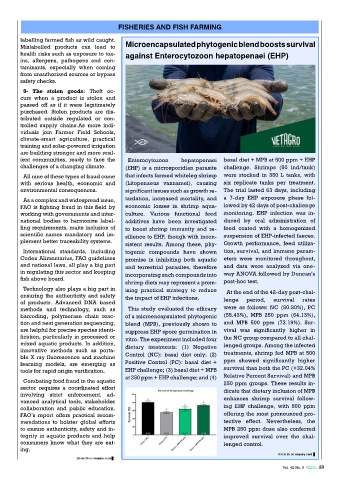
        methods  and  technology,  such  as   This  study  evaluated  the  efficacy   were  as  follows:  NC  (80.80%),  PC
        barcoding,  polymerase  chain  reac-  of a microencapsulated phytogenic   (55.43%),  MPB  250  ppm  (64.13%),
        tion and next generation sequencing,   blend  (MPB),  previously  shown  to   and  MPB  500  ppm  (73.19%).  Sur-
        are helpful for precise species identi-  suppress EHP spore germination in   vival  was  significantly  higher  in
        fication, particularly in processed or   vitro. The experiment included four   the NC group compared to all chal-
        mixed aquatic products. In addition,   dietary  treatments:  (1)  Negative   lenged groups. Among the infected
        innovative  methods  such  as  porta-                                   treatments, shrimp fed MPB at 500
        ble X ray fluorescence and machine   Control  (NC):  basal  diet  only;  (2)   ppm  showed  significantly  higher
        learning  models,  are  emerging  as   Positive Control (PC): basal diet +
        tools for rapid origin verification.  EHP challenge; (3) basal diet + MPB   survival than both the PC (+32.04%
                                             at 250 ppm + EHP challenge; and (4)   Relative Percent Survival) and MPB
         Combating food fraud in the aquatic                                    250 ppm groups. These results in-
        sector  requires  a  coordinated  effort                                dicate that dietary inclusion of MPB
        involving  strict  enforcement,  ad-
        vanced  analytical  tools,  stakeholder                                 enhances  shrimp  survival  follow-
        collaboration  and  public  education.                                  ing  EHP  challenge,  with  500  ppm
        FAO’s  report  offers  practical  recom-                                offering the most pronounced pro-
        mendations  to  bolster  global  efforts                                tective  effect.  Nevertheless,  the
        to ensure authenticity, safety and in-                                  MPB 250 ppm dose also conferred
        tegrity in aquatic products and help                                    improved  survival  over  the  chal-
        consumers  know  what  they  are  eat-                                  lenged control.
        ing.
                                                                                                   Circle 25 on enquiry card
                            Circle 24 on enquiry card                                               Circle 31 on enquiry card
                                                                                                    Vol. 42 No. 6   23

