


Page 24 - AWA Vol.42-No.6 issue
P. 24
FISHERIES AND FISH FARMING

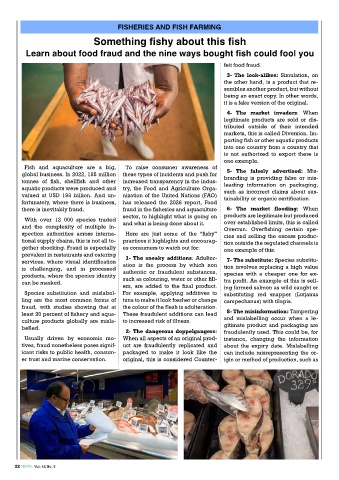
                                  Something fishy about this fish

          Learn about food fraud and the nine ways bought fish could fool you

                                                                                feit food fraud.
                                                                                 3- The  look-alikes:  Simulation,  on
                                                                                the other hand, is a product that re-
                                                                                sembles another product, but without
                                                                                being an exact copy. In other words,
                                                                                it is a fake version of the original.
                                                                                 4-  The  market invaders:  When
                                                                                legitimate  products  are  sold  or  dis-
                                                                                tributed  outside  of  their  intended
                                                                                markets, this is called Diversion. Im-
                                                                                porting fish or other aquatic products
                                                                                into one country from a country that
                                                                                is  not  authorized  to  export  there  is
                                                                                one example.
          Fish  and  aquaculture  are  a  big,   To  raise  consumer  awareness  of
                                                                                 5-  The falsely advertised:  Mis-
         global business. In 2022, 185 million   these types of incidents and push for   branding  is  providing  false  or  mis-
         tonnes  of  fish,  shellfish  and  other   increased transparency in the indus-  leading  information  on  packaging,
         aquatic products were produced and   try,  the  Food  and  Agriculture  Orga-  such  as  incorrect  claims  about  sus-
         valued  at  USD  195  billion.  And  un-  nization of the United Nations (FAO)   tainability or organic certification.
         fortunately, where there is business,   has  released  the  2026  report,  Food
         there is inevitably fraud.         fraud in the fisheries and aquaculture   6-  The market flooding:  When
                                            sector, to highlight what is going on   products are legitimate but produced
          With  over  12  000  species  traded                                  over established limits, this is called
         and  the  complexity  of  multiple  in-  and what is being done about it.  Overrun.  Overfishing  certain  spe-
         spection  authorities  across  interna-  Here  are  just  some  of  the  “fishy”   cies  and  selling  the  excess  produc-
         tional supply chains, this is not all to-  practices it highlights and encourag-  tion outside the regulated channels is
         gether shocking. Fraud is especially   es consumers to watch out for:  one example of this.
         prevalent in restaurants and catering   1- The sneaky additions:  Adulter-
         services,  where  visual  identification   ation  is  the  process  by  which  non   7- The substitute: Species substitu-
         is  challenging,  and  in  processed   authentic  or  fraudulent  substances,   tion involves replacing a high value
         products, where the species identity   such as colouring, water or other fill-  species  with  a  cheaper  one  for  ex-
         can be masked.                                                         tra profit. An example of this is sell-
                                            ers,  are  added  to  the  final  product.   ing farmed salmon as wild caught or
          Species  substitution  and  mislabel-  For  example,  applying  additives  to   substituting  red  snapper  (Lutjanus
         ling  are  the  most  common  forms  of   tuna to make it look fresher or change   campechanus) with tilapia.
         fraud,  with  studies  showing  that  at   the colour of the flesh is adulteration.
         least 20 percent of fishery and aqua-  These fraudulent additions can lead   8- The misinformation: Tampering
         culture  products  globally  are  misla-  to increased risk of illness.  and  mislabelling  occur  when  a  le-
         belled.                                                                gitimate product and packaging are
                                             2- The dangerous doppelgangers:    fraudulently used. This could be, for
          Usually  driven  by  economic  mo-  When all aspects of an original prod-  instance,  changing  the  information
         tives, fraud nonetheless poses signif-  uct  are  fraudulently  replicated  and   about  the  expiry  date.  Mislabelling
         icant risks to public health, consum-  packaged  to  make  it  look  like  the   can  include  misrepresenting  the  or-
         er trust and marine conservation.  original, this is considered Counter-  igin or method of production, such as


       22      Vol. 42 No. 6

