


Page 18 - Vol.38-No.2
P. 18
FISHERIES

                THE FUTURE OF AQUACULTURE DEPENDS ON


         SUSTAINABLE AND FUNCTIONAL FEED INGREDIENTS


          The long-term sustainability of the   such as EPA and DHA, feed attractants   PDQFH IRU ÞVK  GXH WR LWV IHHG DWWUDFWDQW
        aquaculture industry demands a via-  and astaxanthin, making it a key marine   properties, with just 8-10% krill meal
        ble range of alternative ingredients, to   LQJUHGLHQW IRU ÞVK GLHWV  6XVWDLQDELOLW\   IRU       ZHHNV FRQVLGHUHG VXIÞFLHQW WR
        UHGXFH WKH EXUGHQ RQ ÞVKPHDO DQG ÞVK   of ingredient sources is an increasing-  DFKLHYH JURZWK SHUIRUPDQFH EHQHÞWV
        oil for feeds. Antarctic krill products   ly important factor for the aquaculture   • The astaxanthin present in krill meal
        have  emerged  as  strong  contenders   industry, which is why use of Antarc-  WUDQVIHUV WR VDOPRQLG ÞOHWV  LPSURYLQJ
        due to their sustainable sourcing and   tic  krill  is  helping  salmonid  farmers   SLJPHQWDWLRQ DQG RYHUDOO ÞOOHW TXDOLW\
        VLJQLÞFDQW KHDOWK EHQHÞWV  ,Q $NHU %L-  to reduce their reliance on costly and   based on inclusion levels of 10-15%.
        oMarine’s review article, the authors   OLPLWHG LQ VXSSO\ ÞVK SURGXFWV r VD\V   Besides, krill meal inclusion (10-15%)
        DJJUHJDWH NH\ ÞQGLQJV IURP PXOWLSOH   Kiranpreet  Kaur,  PhD,  Director  R&D,   HQKDQFHV WKH ÞOOHW TXDOLW\ E\ LQFUHDV-
        studies on salmonids, to present a ho-  Salmonids, Aker BioMarine.      LQJ ÞUPQHVV DQG E\ UHGXFLQJ JDSLQJ
        OLVWLF RYHUYLHZ RI WKH VSHFLÞF EHQHÞWV
        RI NULOO PHDO RQ WKH ÞVK JURZWK  ÞOOHW   Review article reveals          • Inclusion of 10-15% krill meal in the
        quality, and organ health.           WKHVH NH\ ¶NULOO· EHQHÀWV          VDOPRQLG GLHW LV EHQHÞFLDO IRU OLYHU DQG
                                                                                intestinal health, due to the phospho-
          “This review paper is unique as it’s      for salmonids               lipids, and phospholipid bound EPA
        a  culmination  of  multiple  studies  all                              and DHA in krill that help to reduce fat
                                              • Krill meal inclusion in salmonid feed
        showing  that  krill  meal  has  proven                                 accumulation and inflammation in the
                                            LV VXJJHVWHG WR EH EHQHÞFLDO IRU HQ-
        to be a sustainable source of protein,                                  liver and intestinal tissues.
                                            hancing feed intake and growth perfor-
        phospholipids,  omega-3  fatty  acids
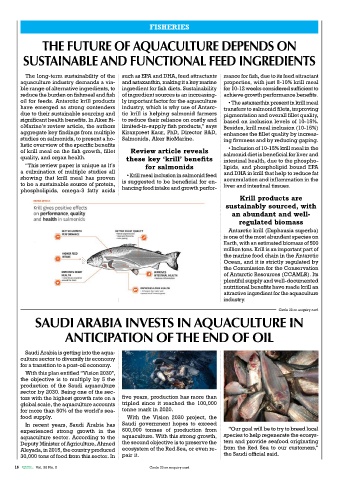
                                                                                     Krill products are
                                                                                sustainably sourced, with
                                                                                  an abundant and well-
                                                                                     regulated biomass
                                                                                 Antarctic krill (Euphausia superba)
                                                                                is one of the most abundant species on
                                                                                Earth, with an estimated biomass of 500
                                                                                million tons. Krill is an important part of
                                                                                the marine food chain in the Antarctic
                                                                                Ocean, and it is strictly regulated by
                                                                                the Commission for the Conservation
                                                                                of Antarctic Resources (CCAMLR). Its
                                                                                plentiful supply and well-documented
                                                                                QXWULWLRQDO EHQHÞWV KDYH PDGH NULOO DQ
                                                                                attractive ingredient for the aquaculture
                                                                                industry.

                                                                                                   Circle 22 on enquiry card
             SAUDI ARABIA INVESTS IN AQUACULTURE IN

                        ANTICIPATION OF THE END OF OIL


          Saudi Arabia is getting into the aqua-
        culture sector to diversify its economy
        for a transition to a post-oil economy.
          With this plan entitled “Vision 2030”,
        the  objective  is  to  multiply  by  5  the
        production  of  the  Saudi  aquaculture
        sector by 2030. Being one of the sec-
        tors with the highest growth rate on a   ÞYH \HDUV  SURGXFWLRQ KDV PRUH WKDQ
        global scale, the aquaculture accounts   tripled  since  it  reached  the  100,000
        for more than 50% of the world’s sea-  tonne mark in 2020.
        food supply.                          With  the  Vision  2030  project,  the
          In  recent  years,  Saudi  Arabia  has   Saudi  government  hopes  to  exceed
        experienced  strong  growth  in  the   600,000  tonnes  of  production  from   “Our goal will be to try to breed local
        aquaculture sector. According to the   aquaculture. With this strong growth,   species to help regenerate the ecosys-
        Deputy Minister of Agriculture, Ahmed   the second objective is to preserve the   tem and provide seafood originating
        Aleyada, in 2015, the country produced   ecosystem of the Red Sea, or even re-  from the Red Sea to our customers,”
        30,000 tons of food from this sector. In   pair it.                     WKH 6DXGL RIÞFLDO VDLG
        16         Vol. 38 No. 2                      Circle 23 on enquiry card

