


Page 26 - AWA Vol.42-No3
P. 26
eNVIrONMeNT CONTrOl

          Solutions to the interconnected climate, biodiversity,

                                              and rangelands

         The United Nations has designated
        2026 as the International Year of Range-
        lands and Pastoralists to spotlight the
        vital role that rangelands and pastoral-
        ist communities play in sustainable food
        production, ecosystem stewardship, and
        climate change mitigation and adapta-
        tion.
         In an interview with FAO Newsroom,
        Thanawat Tiensin, FAO Assistant Direc-
        tor-General and Director of the Animal
        Production and Health Division, ex-
        plained what rangelands are, where they
        are found, how pastoralist systems func-
        tion, and why protecting and investing in
        them is essential for building more sus-
        tainable, resilient and inclusive agrifood
        systems worldwide.
         1. What are rangelands and why are   posed of grass, grass-like plants, forbs,   along with big extensions in the world’s
        they a vital part of the world’s land   shrubs and sometimes trees that pro-  drylands. They are also found in some of
        systems?
                                            vide  ideal  support  for  grazing  wildlife   the world’s most  extreme  climates,  ex-
         Rangelands are lands used, or that can   and livestock, and pastoralist communi-  periencing both the hottest and coldest
        potentially be used, for grazing. They are   ties have thrived in these landscapes for   weather, like the savannahs of the Sahel
        very  diverse  and  comprise  the  world’s   millennia.                 or the grasslands of Scandinavia. There
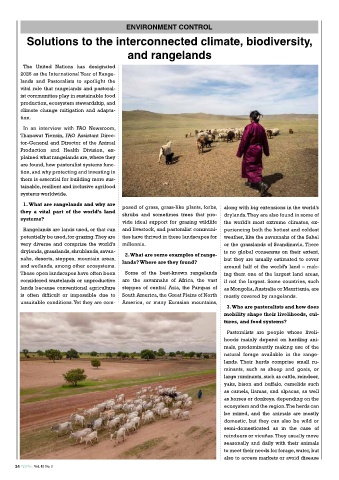
        drylands, grasslands, shrublands, savan-  2. What are some examples of range-  is no global consensus on their extent,
        nahs, deserts, steppes, mountain areas,   lands? Where are they found?  but they are usually estimated to cover
        and wetlands, among other ecosystems.                                   around half of the world’s land – mak-
        These open landscapes have often been   Some of the best-known rangelands   ing them one of the largest land areas,
        considered wastelands or unproductive   are the savannahs of Africa, the vast   if not the largest. Some countries, such
        lands because conventional agriculture   steppes of central Asia, the Pampas of   as Mongolia, Australia or Mauritania, are
        is often difficult or impossible due to   South America, the Great Plains of North   mostly covered by rangelands.
        unsuitable conditions. Yet they are com-  America,  or  many  Eurasian  mountains,
                                                                                 3. Who are pastoralists and how does
                                                                                mobility shape their livelihoods, cul-
                                                                                tures, and food systems?
                                                                                 Pastoralists are people whose liveli-
                                                                                hoods mainly depend on herding ani-
                                                                                mals, predominantly making use of the
                                                                                natural  forage  available  in  the  range-
                                                                                lands.  Their herds comprise small ru-
                                                                                minants, such as sheep and goats, or
                                                                                large ruminants, such as cattle, reindeer,
                                                                                yaks, bison and buffalo, camelids such
                                                                                as  camels, llamas, and alpacas, as well
                                                                                as horses or donkeys, depending on the
                                                                                ecosystem and the region. The herds can
                                                                                be mixed, and the animals are mostly
                                                                                domestic, but they can also be wild or
                                                                                semi-domesticated as in the case of
                                                                                reindeers or vicuñas. They usually move
                                                                                seasonally and daily with their animals
                                                                                to meet their needs for forage, water, but
                                                                                also to access markets or avoid disease
       24      Vol. 42 No. 3

