


Page 21 - AWA Vol.41-No.8
P. 21
FISHERIES AND FISH FARMING

         ids, and other nutrients.
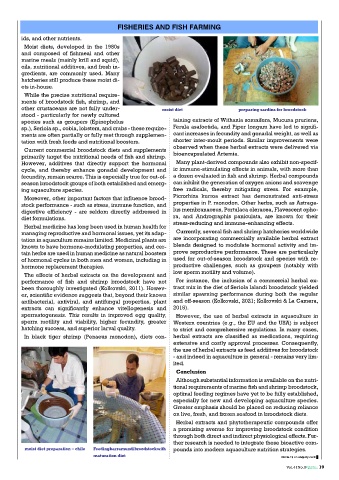
          Moist  diets,  developed  in  the  1980s
         and  composed  of  fishmeal  and  other
         marine meals (mainly krill and squid),
         oils, nutritional additives, and fresh in-
         gredients,  are  commonly  used.  Many
         hatcheries still produce these moist di-
         ets in-house.
          While the precise nutritional require-
         ments of broodstock fish, shrimp, and
         other crustaceans are not fully under-           moist diet                 preparing sardins for broodstock
         stood - particularly for newly cultured
         species  such  as  groupers  (Epinephelus            taining extracts of Withania somnifera, Mucuna pruriens,
         sp.), Seriola sp., cobia, lobsters, and crabs - these require-  Ferula asafoetida, and Piper longum have led to signifi-
         ments are often partially or fully met through supplemen-  cant increases in fecundity and gonadal weight, as well as
         tation with fresh feeds and nutritional boosters.    shorter inter-moult periods. Similar improvements were
          Current commercial broodstock diets and supplements   observed when these herbal extracts were delivered via
         primarily target the nutritional needs of fish and shrimp.   bioencapsulated Artemia.
         However,  additives  that  directly  support  the  hormonal   Many plant-derived compounds also exhibit non-specif-
         cycle,  and  thereby  enhance  gonadal  development  and   ic immune-stimulating effects in animals, with more than
         fecundity, remain scarce. This is especially true for out-of-  a dozen evaluated in fish and shrimp. Herbal compounds
         season broodstock groups of both established and emerg-  can inhibit the generation of oxygen anions and scavenge
         ing aquaculture species.                             free  radicals,  thereby  mitigating  stress.  For  example,
          Moreover, other important factors that influence brood-  Picrorhiza  kurroa  extract  has  demonstrated  anti-stress
         stock performance - such as stress, immune function, and   properties in P. monodon. Other herbs, such as Astraga-
         digestive  efficiency  -  are  seldom  directly  addressed  in   lus membranaceus, Portulaca oleracea, Flavescent opho-
         diet formulations.                                   ra,  and  Andrographis  paniculata,  are  known  for  their
                                                              stress-reducing and immune-enhancing effects.
          Herbal medicine has long been used in human health for
         managing reproductive and hormonal issues, yet its adap-  Currently, several fish and shrimp hatcheries worldwide
         tation in aquaculture remains limited. Medicinal plants are   are incorporating commercially available herbal extract
         known to have hormone-modulating properties, and cer-  blends designed to modulate hormonal activity and im-
         tain herbs are used in human medicine as natural boosters   prove reproductive performance. These are particularly
         of hormonal cycles in both men and women, including in   used  for  out-of-season  broodstock  and  species  with  re-
         hormone replacement therapies.                       productive  challenges,  such  as  groupers  (notably  with
          The effects of herbal extracts on the development and   low sperm motility and volume).
         performance  of  fish  and  shrimp  broodstock  have  not   For  instance,  the  inclusion  of  a  commercial  herbal  ex-
         been thoroughly investigated (Kolkovski, 2011). Howev-  tract mix in the diet of Seriola lalandi broodstock yielded
         er, scientific evidence suggests that, beyond their known   similar  spawning  performance  during  both  the  regular
         antibacterial,  antiviral,  and  antifungal  properties,  plant   and off-season (Kolkovski, 2021; Kolkovski & La Camera,
         extracts  can  significantly  enhance  vitellogenesis  and   2015).
         spermatogenesis.  This  results  in  improved  egg  quality,   However,  the  use  of  herbal  extracts  in  aquaculture  in
         sperm  motility  and  viability,  higher  fecundity,  greater   Western countries (e.g., the EU and the USA) is subject
         hatching success, and superior larval quality.       to strict and comprehensive regulations. In many cases,
          In  black  tiger  shrimp  (Penaeus  monodon),  diets  con-  herbal  extracts  are  classified  as  medications,  requiring
                                                              extensive and costly approval processes. Consequently,
                                                              the use of herbal extracts as feed additives for broodstock
                                                              - and indeed in aquaculture in general - remains very lim-
                                                              ited.
                                                               Conclusion
                                                               Although substantial information is available on the nutri-
                                                              tional requirements of marine fish and shrimp broodstock,
                                                              optimal feeding regimes have yet to be fully established,
                                                              especially for new and developing aquaculture species.
                                                              Greater emphasis should be placed on reducing reliance
                                                              on live, fresh, and frozen seafood in broodstock diets.
                                                               Herbal extracts and phytotherapeutic compounds offer
                                                              a promising avenue for improving broodstock condition
                                                              through both direct and indirect physiological effects. Fur-
                                                              ther research is needed to integrate these bioactive com-
          moist diet preparation – chile  Feeding barramundi broodstock with   pounds into modern aquaculture nutrition strategies.
                                  maturation diet
                                                                                                    Circle 19 on enquiry card
                                                                                                      Vol. 41 No. 8   19

