


Page 6 - Vol.39-No.6
P. 6
CROP PROTECTION


                                                     SEEDING THE SUCCESS


                                                               FOR OIL PALM


                                            a) nigrescens with violet to black unripe   1. Breaking of dormancy
                                            fruits, and ripe fruits with a brown or black   2. Germination induction
                                            cap. b) virescens having green unripe fruits
                                            ripening to reddish orange  and c) albescens   The Germinator
                                            fruit without the reddish colour because   Dormancy break and germination induc-
                                            it lacks carotenoid pigments        tion are carried out in the same custom-de-
                                              The tenera type usefully combines a thin  signed ‘building’ called a’ germinator’, at
          DR. TERRY MABBETT                 shell (easy to crack during processing), and  specific temperatures and seed moisture
                                            a high proportion of pulp. It is the biotype  levels and for varying lengths of time. A
                                            usually grown on commercial oil palm plan-  typical germinator comprises a separate
          Oil palm plantations around the world   tations, and dominated by the nigrescens  and enclosed heated space for breaking
        have their roots in the humid lowland trop-  fruit type as a series of commercial hybrids  dormancy and an associated ‘cool’ area
        ics of Africa and where the African oil palm   developed for high oil content.   where seeds are placed for germination,
        (Elais guineensis) originates. It was first   But with plant breeding and the use of   all within a custom-designed building.
        carried and spread by man from Senegal to   sophisticated hybrids come restrictions and   The isolated, heated area is an enclosed
        Angola in a broad swathe along the coast   responsibilities related to the selection and  chamber, equipped with double glazed win-
        and into the interior along the path of the   germination of seed. It is pointless for pro-  dows, double walls with, 13 cm space, and
        Congo River.                        ducers to ‘save their own seed’ for these  a double layered ceiling all designed to insu-
          Oil palm readily grows, multiplies and   will just produce a mixture of sterile piserfa,  late the structure and maintain the intensity
        spreads itself in forest clearings and shifting   dura and tenera palms and offering poor  and consistency of heat required. Inside
        cultivation will typically create large areas   performance compared with the improved  are 61 cm wide slatted shelves, 35 cm
        of semi-wild oil palm groves. Like most   plant material of the previous (parental)  apart, sufficient to support 10-12 plastic
        tropical tree crops, including rubber and   generation.                 bags per metre length of shelf. Each bag
        cocoa, oil palm was originally exploited by                             will contain some 1000-1500 seeds. The
        ‘gatherer’ communities, who picked nuts                                 building is heated using conduction and
        from wild and semi-wild palms. In the nine-                             convection via hot water pipes or elec-
        teenth century enterprising communities                                 tric heaters and is always thermostatically
        began to cultivate oil palm by planting seed                            controlled.
        with regular trade in palm oil and kernels
        between West Africa and Europe starting                                 Breaking of dormancy
        at this time.                                                            On arrival at the germinator seeds are
          Subsequent development of plant breed-                                given identifying codes, to distinguish be-
        ing technology has produced high fruit and                              tween hybrids or seeds obtained from an
        oil yielding hybrids that underpin today’s                              individual cross. They are held in an air-con-
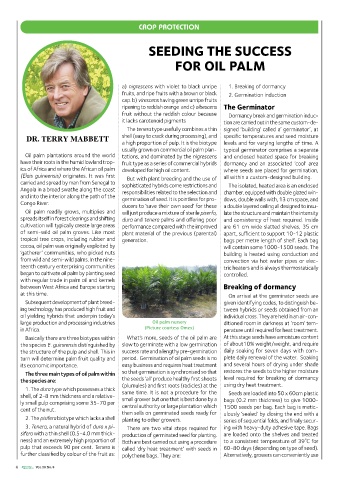
        large production and processing industries     Oil palm nursery         ditioned room in darkness at ‘room’ tem-
        in Africa.                                  (Picture courtesy Omex)     perature until required for heat treatment.
          Basically there are three biotypes within   What’s more, seeds of the oil palm are  At this stage seeds have a moisture content
        the species E. guineensis distinguished by  slow to germinate with a low germination  of about10% weight/weight, and require
        the structure of the pulp and shell. This in  success rate and a lengthy pre-germination  daily soaking for seven days with com-
        turn will determine palm fruit quality and  period.  Germination of oil palm seeds is no  plete daily renewal of the water.  Soaking
        its economic importance.            easy business and requires heat treatment  and several hours of drying under shade
          The three main types of oil palm within   so that germination is synchronised so that  restores the seeds to the higher moisture
        the species are:                    the seeds ‘all’ produce healthy first shoots  level required for breaking of dormancy
          1. The dura type which possesses a thick   (plumules) and first roots (radicles) at the  using dry heat treatment.
                                            same time. It is not a procedure for the
        shell, of 2-8 mm thickness and a relative-                               Seeds are loaded into 50 x 60cm plastic
        ly small pulp comprising some 35-70 per   small grower but one that is best done by a  bags (0.2 mm thickness) to give 1000-
        cent of the nut.                    central authority or large plantation which  1500 seeds per bag. Each bag is metic-
                                            then sells on germinated seeds ready for  ulously ‘sealed’ by closing the end with a
          2. The pisifera biotype which lacks a shell  planting to other growers.  series of sequential folds, and finally secur-
          3. Tenera, a natural hybrid of dura x pi-  There are two vital steps required for  ing with heavy-duty adhesive tape. Bags
        sifera with a thin shell (0.5-4.0 mm thick-  production of germinated seed for planting.  are loaded onto the shelves and treated
                                                                                                            o
        ness) and an extremely high proportion of   Both are best carried out using a procedure  to a consistent temperature of 39 C for
        pulp that exceeds 90 per cent. Tenera is   called ‘dry heat treatment’ with seeds in  60-80 days (depending on type of seed).
        further classified by colour of the fruit as:   polythene bags. They are:   Alternatively, growers can conveniently use

       4      Vol. 39 No. 6

