


Page 28 - Vol.39-No.1
P. 28
MODERNIZING FOOD SAFETY

                    MODERNIZING FOOD SAFETY WHILE

                             PRESERVING TRADITIONS IN


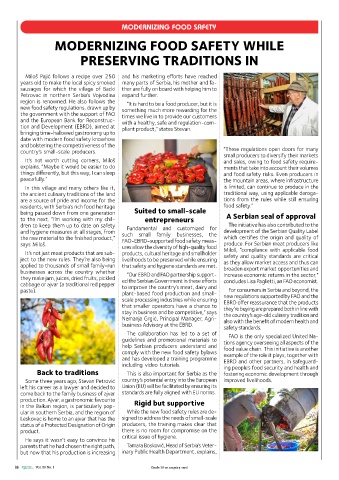
          Miloš Pajić follows a recipe over 250  and his marketing efforts have reached
        years old to make the local spicy smoked  many parts of Serbia, his mother and fa-
        sausages  for which the village of Backi  ther are fully on board with helping him to
        Petrovac in northern Serbia’s Vojvodina  expand further.
        region is renowned. He also follows the   “It is hard to be a food producer, but it is
        new food safety regulations, drawn up by   something much more rewarding for the
        the government with the support of FAO   times we live in to provide our customers
        and the European Bank for Reconstruc-  with a healthy, safe and regulation-com-
        tion and Development (EBRD), aimed at   pliant product,” states Stevan.
        bringing time-hallowed gastronomy up to
        date with modern food safety knowhow
        and bolstering the competitiveness of the
        country’s small-scale producers.                                        “These regulations open doors for many
                                                                                small producers to diversify their markets
          It’s not worth cutting corners, Miloš                                 and sales, owing to food safety require-
        explains. “Maybe it would be easier to do                               ments that take into account their volumes
        things differently, but this way, I can sleep                           and food safety risks. Even producers in
        peacefully.”                                                            the mountain areas, where infrastructure
          In this village and many others like it,                              is limited, can continue to produce in the
        the ancient culinary traditions of the land                             traditional way, using applicable deroga-
        are a source of pride and income for the                                tions from the rules while still ensuring
        residents, with Serbia’s rich food heritage                             food safety.”
        being passed down from one generation    Suited to small-scale           A Serbian seal of approval
        to the next. “I’m working with my chil-     entrepreneurs
        dren to keep them up to date on safety   Fundamental and customized for   The initiative has also contributed to the
        and hygiene measures at all stages, from   such small family businesses, the   development of the Serbian Quality Label
        the raw material to the finished product,”   FAO-EBRD-supported food safety meas-  which certifies the origin and quality of
        says Miloš.                         ures allow the diversity of high-quality food   produce. For Serbian meat producers like
          It’s not just meat products that are sub-  products, cultural heritage and smallholder   Miloš, “compliance with applicable food
                                                                                safety and quality standards are critical
        ject to the new rules. They’re also being  livelihoods to be preserved while ensuring   as they allow market access and thus can
        applied to thousands of small family-run  that safety and hygiene standards are met.   broaden export market opportunities and
        businesses  across  the  country  whether   “Our EBRD and FAO partnership support-  increase economic returns in the sector,”
        they make jam, juices, dried fruits, pickled   ed the Serbian Government in these efforts  concludes Lisa Paglietti, an FAO economist.
        cabbage or ajvar (a traditional red pepper   to improve the country’s meat, dairy and
        paste).                                                                  For consumers in Serbia and beyond, the
                                            plant-based food production and small-  new regulations supported by FAO and the
                                            scale processing industries while ensuring   EBRD offer reassurance that the products
                                            that smaller operators have a chance to   they’re buying are prepared both in line with
                                            stay in business and be competitive,” says   the country’s age-old culinary tradition and
                                            Nemanja Grgić, Principal Manager, Agri-  also with the benefit of modern health and
                                            business Advisory at the EBRD.
                                                                                safety standards.
                                              The  collaboration  has  led  to  a  set  of   FAO is the only specialized United Na-
                                            guidelines and promotional materials to   tions agency overseeing all aspects of the
                                            help Serbian producers understand and   food value chain. This initiative is another
                                            comply with the new food safety bylaws   example of the role it plays, together with
                                            and has developed a training programme   EBRD and other partners, in safeguard-
                                            including  video  tutorials.        ing people’s food security and health and
              Back to traditions              This is also important for Serbia as the  fostering economic development through
          Some three years ago, Stevan Petrović   country’s potential entry into the European  improved livelihoods.
        left his career as a lawyer and decided to   Union (EU) will be facilitated by ensuring its
        come back to the family business of ajvar   standards are fully aligned with EU norms.
        production. Ajvar, a gastronomic favourite
        in the Balkan region, is particularly pop-  Rigid but supportive
        ular in southern Serbia, and the region of   While the new food safety rules are de-
        Leskovac is home to an ajvar that has the  signed to address the needs of small-scale
        status of a Protected Designation of Origin  producers, the training makes clear that
        product.                            there is no room for compromise on the
                                            critical issue of hygiene.
          He says it wasn’t easy to convince his
        parents that he had chosen the right path,   Tamara Bosković, Head of Serbia’s Veter-
        but now that his production is increasing  inary Public Health Department, explains,

      26         Vol. 39 No. 1                        Circle 39 on enquiry card

