


Page 20 - AWA Vol.37 No.4
P. 20
POULTRY


        the hens restless, uncomfortable and   Important rules for good          • Use no more than 2 to 3 cm of litter
        reluctant to use the nests.              nest management                in the scratch area. When the floor is

        Egg collection                        • Enough nest space is crucial. Birds   warm and birds feel comfortable, they
                                                                                may prefer to lay their eggs on the floor
          Manual nests: At around 20% produc-  don’t want to wait. For a mechanical   instead of the nest.
        tion, egg collection should be done   community nest allow a minimum of
        twice per day. Increase the collection   100 cm2 nest space for 1 hen ( 1 m2  or
        frequency as the weekly production in-  100 hens).  Another option is to calcu-
        creases. In full production, collect eggs   late 100 females /m of house length of
        at least four times a day and during   nest systems.
        peak production, six times a day.     • The type of community nest is very
          Mechanical community nests:  With   important to attract the females to the
        a mechanical nest system, start  the   nests.  Do research to determine which
        first egg collection when about 10 to   nests have a history of low floor and
        15 eggs are laid on the belt. Do the first   slat eggs.
        collection in the afternoon so there are   • Open the nest when the first egg is
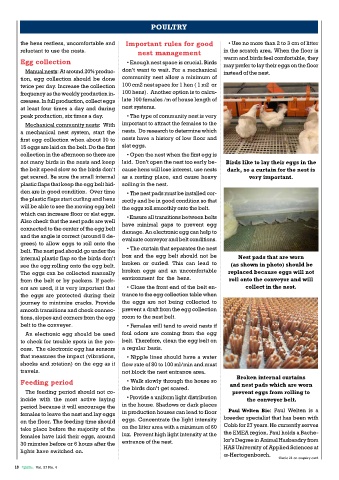
        not many birds in the nests and keep   laid.  Don’t open the nest too early be-  Birds like to lay their eggs in the
        the belt speed slow so the birds don’t   cause hens will lose interest, use nests   dark, so a curtain for the nest is
        get scared. Be sure the small internal   as a resting place, and cause heavy    very important.
        plastic flaps that keep the egg belt hid-  soiling in the nest.
        den are in good condition.  Over time   • The nest pads must be installed cor-
        the plastic flaps start curling and hens   rectly and be in good condition so that
        will be able to see the moving egg belt   the eggs roll smoothly onto the belt.
        which can increase floor or slat eggs.   • Ensure all transitions between belts
        Also check that the nest pads are well   have minimal  gaps to prevent egg
        connected to the center of the egg belt   damage. An electronic egg can help to
        and the angle is correct (around 8 de-  evaluate conveyor and belt conditions.
        grees) to allow eggs to roll onto the
        belt. The nest pad should go under the   • The curtain that separates the nest
        internal plastic flap so the birds don’t   box  and  the  egg  belt  should  not  be   Nest pads that are worn
        see the egg rolling onto the egg belt.   broken or curled. This can lead to    (as shown in photo) should be
        The eggs can be collected manually   broken eggs  and an uncomfortable   replaced because eggs will not
        from the belt or by packers. If pack-  environment for the  hens.        roll onto the conveyor and will
        ers are used, it is very important that   • Close the front end of the belt en-  collect in the nest.
        the  eggs  are protected  during  their   trance to the egg collection table when
        journey to minimize cracks. Provide   the eggs are not being collected to
        smooth transitions and check connec-  prevent a draft from the egg collection
        tions, slopes and corners from the egg   room to the nest belt.
        belt to the conveyer.                 • Females will tend to avoid nests if
          An electronic egg should be used   foul odors are coming from the egg
        to check for trouble spots in the pro-  belt. Therefore, clean the egg belt on
        cess.  The electronic egg has sensors   a regular basis.
        that measures the impact (vibrations,   • Nipple lines should have a water
        shocks and rotation) on the egg as it   flow rate of 80 to 100 ml/min and must
        travels.                            not block the nest entrance area.
                                                                                    Broken internal curtains
        Feeding period                        • Walk slowly through the house so   and nest pads which are worn
                                            the birds don’t get scared.
          The feeding period should not co-                                        prevent eggs from rolling to
        incide with the most active laying    • Provide a uniform light distribution    the conveyor belt.
        period because it will encourage the   in the house. Shadows or dark places   Paul Welten  Bio: Paul  Welten is a
        females to leave the nest and lay eggs   in production houses can lead to floor   breeder specialist that has been with
        on the floor. The feeding time should   eggs. Concentrate the light intensity   Cobb for 27 years. He currently serves
        take place before the majority of the   on the litter area with a minimum of 60   the EMEA region. Paul holds a Bache-
        females have laid their eggs, around   lux.  Prevent high light intensity at the   lor’s Degree in Animal Husbandry from
        30 minutes before or 6 hours after the   entrance of the nest.          HAS University of Applied Sciences at
        lights have switched on.
                                                                                ‹s-Hertogenbosch.
                                                                                                   Circle 21 on enquiry card
        18         Vol. 37 No. 4

